
What do parties think about cryptocurrency and blockchain?

News website Cointelegraph researched six major political parties in Germany and found out what to expect from the new government in terms of crypto regulation.
The use of new technologies has become such as blockchain Or artificial intelligence has been in the spotlight recently and is gaining more acceptance from governments around the world.
Sunday, 26 September, the Germans voted in the parliamentary elections that were the end 16 years For Angela Merkel in power.
for a year 2005Germany experienced deep crises, but it also experienced unprecedented prosperity.
creates departure Merkel A power vacuum, but it also creates an opportunity for a fresh start while not excluding the cryptocurrency sector.
But what would this new beginning look like?
What are German parties planning to do to help the crypto market and new technologies like Blockchain؟
cast down Coin telegraph Look at the electoral data, and search for keywords such as “cryptocurrency” or “cryptocurrency.” Blockchain or “digital euro” and asked the parties what they thought of the regulation of the cryptocurrency market.
The Social Democratic Party of Germany won 206 seats
The relationship of the SPD can be explained by the center-left (SDP Cryptocurrency in a nutshell:
The cryptocurrency market does not seem to play a role for Germany's largest political party, which includes most of the members.
It seems that some words like 'Bitcoin or “cryptocurrencies” the party had forgotten in Future program(English: Manifesto for the Future) i.e. the Future List, which is the title of the election manifesto of the Social Democratic Party.
In only one place is there a negative mention of private cryptocurrencies like Project Facebook Diem Or the so-called stable coins.
Not even the digital euro appears in the SPD election document.
The two brotherly parties won CDU And CSU, known as “Al Ittihad” – with 196 seats
Until the middle of the year 2019It was the center-right parties CDU / CSU Decisive regarding cryptocurrency, after which the party launched a strategy Blockchain his own.
In the opinion of CDU / CSU, enjoy technique Blockchain With great potential, Germany will become a world leader in the field of Blockchain.
Already started 90% of procedures (40 out of 44) of strategy Blockchain of its own, including milestones such as the opening of the German law on digital securities.
The union wants to continue to push projects Blockchain Experimental.
On the topic of cryptocurrency, he calls CDU / CSU To progressive but responsible regulation and tighter KYC rules.
The electoral manifesto states the following:
“The acquisition of real estate by cash payment should only be possible through the banks, which must first verify the identity of the buyer and the origin of the money as part of an existing business relationship; The same is true when exchanging cash for cryptocurrency and vice versa.
Tokenized securities, on the other hand, are much more than focus on CDU / CSU It is openly defended by the party.
It seems that the digital euro as a fast, simple and secure payment method and as an alternative to cash is also important for CDU / CSU But according to the party, one has to take cautious steps.”
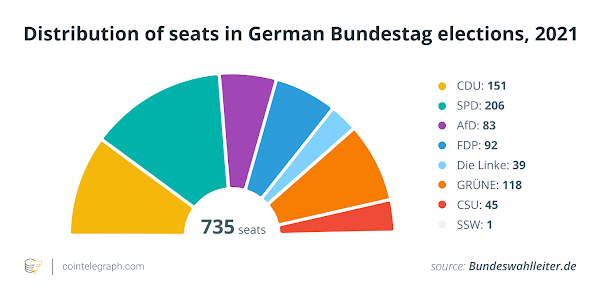
The Green/90 Alliance won 118 seats
Green understands the importance of technology Blockchain But they want to keep this innovation under state control.
According Lisa Bowes Green Party spokeswoman for fiscal policy told Coin telegraph:
“Cryptocurrencies bring risks such as massive energy consumption, abuse by criminals and excessive speculation.
Essentially, as with all innovations in the financial sector, the same rules should apply here as for other classic financial products with regard to consumer protection, transparency and financial stability.”
In principle, green supports the European Central Bank's plans to create its own digital euro.
According The European Union needs its own infrastructure in the financial sector to secure its sovereignty as well as the international role of the euro. She said:
“It is important to us that the digital euro ensures data and legal security for consumers and businesses and does not threaten financial stability.
With the digital euro, we can also counteract the unjustified costs caused by oligopolies.
However, the digital euro does not replace classical money, but rather complements it.”
Such as SPD Green rejects special coins or stable coins.
The party fears the erosion of state control over the currency, and therefore wants to take decisive action against it.
The Green Party’s election manifesto also intends to completely eliminate tax breaks for cryptocurrency investments longer than one year.
Currently, Germany only taxes cryptocurrencies or precious metals, such as gold or silver, if they are sold in the same year they were purchased.
That being said, cryptocurrency traders who use digital assets for long-term financial investment and don't move to them often can make tax-free profits in Germany.
According to the Green Party, no matter how much time you hold sooner or later, the state will want to cut it out.
Free Democratic Party - won 92 seats
In its election manifesto, the pro-free market Free Democratic Party (FDP) calls for a friendly policy toward cryptocurrencies.
It says it wants to create an innovation-friendly legal framework for crypto assets and enable digital securities of all kinds.
Johannes Mellin, press officer for FDP, for Cointelegraph:
“Clear standards can enable relevant companies and consumers to use Blockchain more securely and thus contribute to better technology adaptation
Regulation should not be too strict, but rather act as a barrier to market entry.”
be seen FDP Liberal New Opportunities in Blockchain, especially in the energy or financial services sector.
Depending on the party, it can be a system Blockchain The emerging market is one of the most powerful game-changing factors in the capital markets and in the fintech sector in the next 10 years.
According for two millenniums, can technology Blockchain To open up more previously illiquid assets for investment from the public.
For this reason, he calls FDP To change the national and European legal framework.
suggest FDP Also called "digital freedom zones" In Germany.
Areas such as these, also referred to as regulatory sandboxes, will unlock startups in the field of Blockchain and cryptocurrencies from regulations and supervision by the Federal Financial Supervisory Authority (BaFin) so that they can try out new concepts and prototypes.
As far as the digital euro is concerned, see FDP It is a fast and safe alternative to cash.
However, according to the Liberal Party, the e-euro should not abolish or replace cash.
Alternative for Germany (AfD) – won 83 seats
Although some politicians in the AfD (AfD) have spoken out in favor of Bitcoin (BTC) and cryptocurrencies in the past, but the topic finds no place in their current election manifesto “Germany.
The right-wing populist party has dropped just one sentence about central bank digital currency, stating that it is strongly opposed to central bank coins.
The right-wing populist party is sure of only one thing: criticism must be preserved at all costs.
The AfD demands that criticism be permanently preserved as a civil right and established in common law.
Left - won 39 seats
The left wants stronger regulation of digital payment systems in general.
In addition, the party believes that the state's monopoly on currency is threatened by the privatization of money.
First and foremost by companies like Facebook and plans for a supplementary currency, dim.
But cryptocurrencies, of course, also do not conform to the leftist dogma that money should be owned by the state.
Confirms the left This is for Cointelegraph:
“Cryptocurrencies provide little benefit to society and have harmful side effects.”
Shows the left that Bitcoin It didn't fund our daily consumption, and it wasn't Bitcoin Also related to the stability of sufficient value, it was not guaranteed to maintain or increase its value.
Therefore, the left demands stricter regulation of cryptocurrencies and better financial protection for consumers.
In the opinion of the left, the FSA should, BaFin Regulating cryptocurrency trading to “protect investors from high losses.”
In addition, the left calls for a ban on cryptocurrency mining.
The party told Cointelegraph that it still saw that generation Bitcoin Cryptocurrencies are a waste of energy and resources:
“Bitcoin It is also an environmental resource because mining consumes a large amount of electricity.
Moreover, there is an urgent need to take action to put an end to cryptocurrency money laundering.
Bitcoin It is the dark web of finance.”
However, the crypto cash terminal is open to the digital euro.
The left even tried to put the digital euro on the agenda Bundestag During the last legislative period:
“We are in favor of a safe and innovative digital euro, but it in no way replaces cash, only complements it.
The digital euro will be as secure as cash, will enable its own level of data protection and will support the digitization of the economy, such as the automation of the above-mentioned processes.”
According to the Left Party, Blockchain It is an innovation with great potential, particularly in process automation.
However, as the left mentioned, it did not make sense to use Blockchain To check electricity-intensive accounting via decentralized computers, which are generally provided by banks without errors.
Summary of Germany's elections: Expect tighter regulation
How will the future government made up of these six parties deal with the issue of regulating cryptocurrency and technology Blockchain It still has to be seen.
Changes such as tighter Know Your Customer regulations and tougher regulation of the crypto economy can be expected soon.
After all, both sides agree on one point:
Money laundering and terrorist financing must be fought more vigorously, and many parties (except FDP Cryptocurrencies are seen as “dirty” money that lacks control.
Also, private cryptocurrencies like Diem Or stable coins will not find support from the German government due to the fear that they may undermine the state's monopoly on money.
Only the FDP abstaining from the ban speech, but the SPD candidate for chancellor, Olaf Schultz On the other hand, he often advocated private cryptocurrencies.


0 Comments
Any Queries , You May Ask